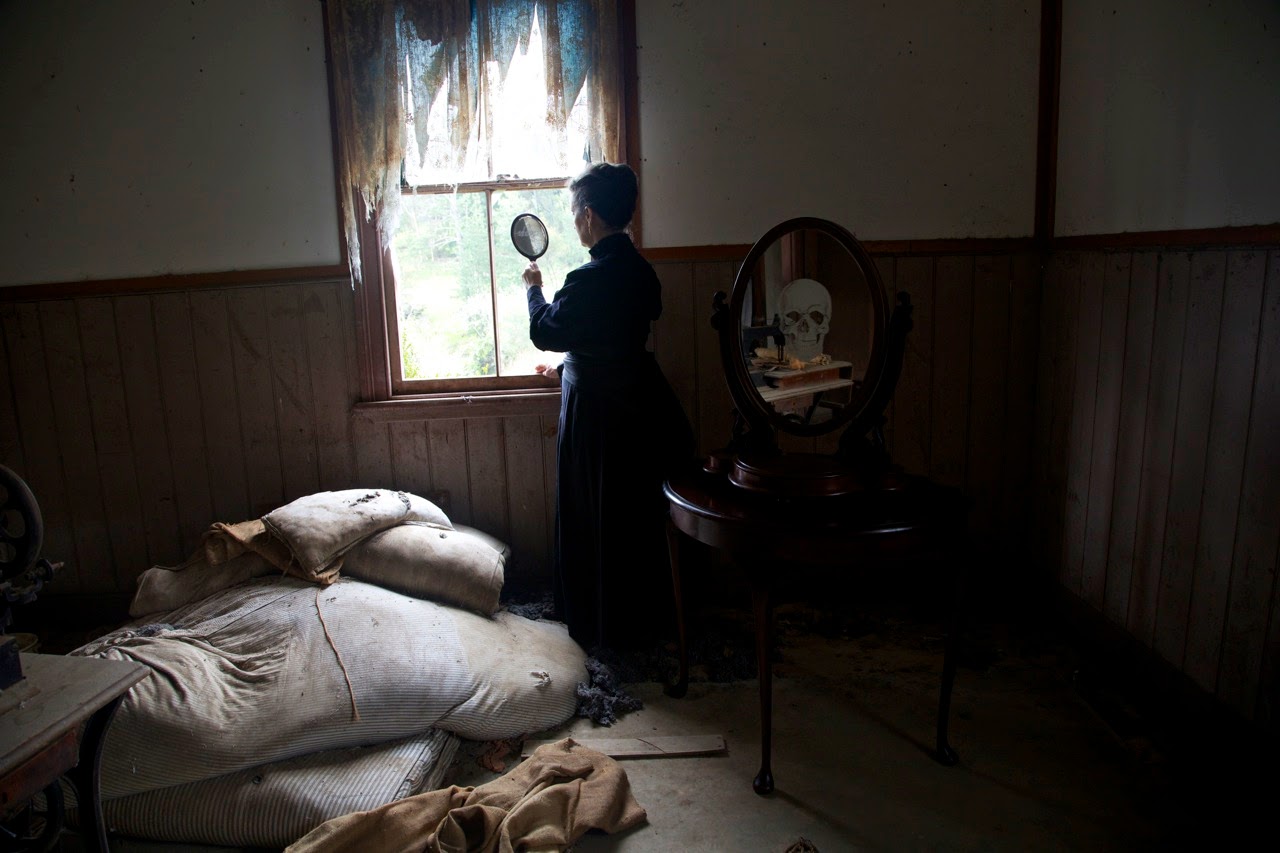
Perhaps it was the rhyming
of tea and Burrowye that had the regional ABC reporter who interviewed me at
7.30 am so completely disinterested in the purpose of this event.
Charlotte Houston from
Burrowye (see earlier post) had invited me to a festival at Burowye Station at
which I was going to appear as Isabella Robertson. We had a few loose emails
back and forth about how this would unfold, possibly involving a dialogue
between myself and Charlotte in characters not our own.
What started out as a
'salon' was rebranded along the way.
According to Wikipedia 'A
Salon is a gathering of people under the roof of an inspiring host, held partly
to amuse one another and partly to refine the taste and increase the knowledge
of the participants through conversation.'
Charlotte was definitely an
inspiring host. With new baby Dora on her hip she arranged beautiful food,
'bone tea' in fine bone china, a massage room complete with masseur, a shop The Burrowye Store, selling local produce,
introductions to the gathering guests and then finally found time to dress in
her wedding dress as well as baby Dora in her christening clothes that had been
finely knitted by James's Grandmother, all ready for the salon.
 |
| Beautiful food by Rochene |
 |
| Equally beautiful music |
Dressing as Isabella held its own difficulties as the corset which I wore underneath the high necked 1800's costume didn't let me sit down for more than a few minutes without cutting off my airways. I understood how women from that time had fainted from having too tight a corset. I hadn't had the obligatory lower rib removed. When we were all assembled in the drawing room there were approximately 25 to 30 people, mostly squatters and their families from the area sitting in balloon back chairs in the very location that my great grandparents had most likely held similar style of salons. However the purpose of this salon was very different.
 |
| Charlotte looking appropriately like an angel |
I began by introducing myself and telling the story of my project KELOID including the meaning of its name. Keloid is variously used to describe both an unsightly scar from the healing of a wound, and a sign of initiation or significant life event. The intention of this project is to produce a 'beautiful scar' through the healing of a wound as the outcome of recognition and acknowledgement.
I spoke about how I had come to realise that my family were directly involved in the occupation of this country, even the country that we were standing on, and how through my marriage to Les, I had directly witnessed the impact of that on Aboriginal people as intergenerational trauma.
 |
| Fog on the weir on our way out the next morning |
As I spoke I could feel the weight of my words in how they were being received by my audience. The significance was not lost on them, even though I was only speaking about my own journey. Some were obviously resistant but most were just plain confronted. I recognised my own painful feelings as I had begun several years ago to directly confront this issue.
I had great compassion for them as they still lived on the land and many had generations of investment both emotional and financial in that land, and to confront that it had been taken by immoral and violent means was even more difficult for them. While I was not pointing at anyone but my own family, no-one failed to realise that theirs was the same journey to be undertaken. James Houston, the other inspiring host, said that it was all very well to say that I was only examining my own families part in colonisation, that what I was doing would affect others too.

To this I responded that I did understand this but I hoped that others would also see the benefit through me. I described how powerful it was for me to know who I was by examining what and where I had come from. I also talked of the possibility of real reconciliation for the country. The extraordinary possibility of a place where Aboriginal people and culture is understood as the foundation of our country. Where the full wisdom, social cohesion and creativity of their culture is restored in the understanding of all Australians, and where we are all able to fully look an Aboriginal person in the eyes and know them as our equal partners in building a country that could find a way to flourish culturally and environmentally in uncertain time, based on the integrity that comes with having dealt with unfinished business in our past.
I know that I have only just begun in developing this conversation so that it can be heard by the breadth of positions that exist in white Australia, however I was moved by how many people came up to me at the end and said that they were moved by what I had said, they thought I was very brave, that it made them think and one young girl came to say how inspired she was. I know that there is a lot of work ahead of me and while it is very different speaking to people who already agree with me, I was SO grateful to Charlotte and James and their generous friends and family for giving me the opportunity to learn to speak about it to new ears.
All of this should be held inside a deep compassion for the pain that Aboriginal people have been through and still experience. The difficulty of confronting our past is in no way comparable to the difficulty of being at the effect of it. However there is something to be responsible for about how hard it is for human beings to admit they are wrong and own up to the bad things we have done. It is not a physical pain or even emotional, it is more ontological. It affects who we are for ourselves at the very core and we don't have the luxury of righteousness which is clearly in the hands of the victims.
Aboriginal people aren't victims. They have done a remarkable job at surviving and in many cases now flourishing but as we non-Aboriginal people begin to take responsibility for our past they are enable to step fully into their place in society and contribute to us in a way we have never allowed.
We all can only benefit from that.